The concept
A multi-agent system splits one big job across several agents. A lead agent (the orchestrator, Day 42) plans the work and hands parts to subagents. Each works on its own and reports back.
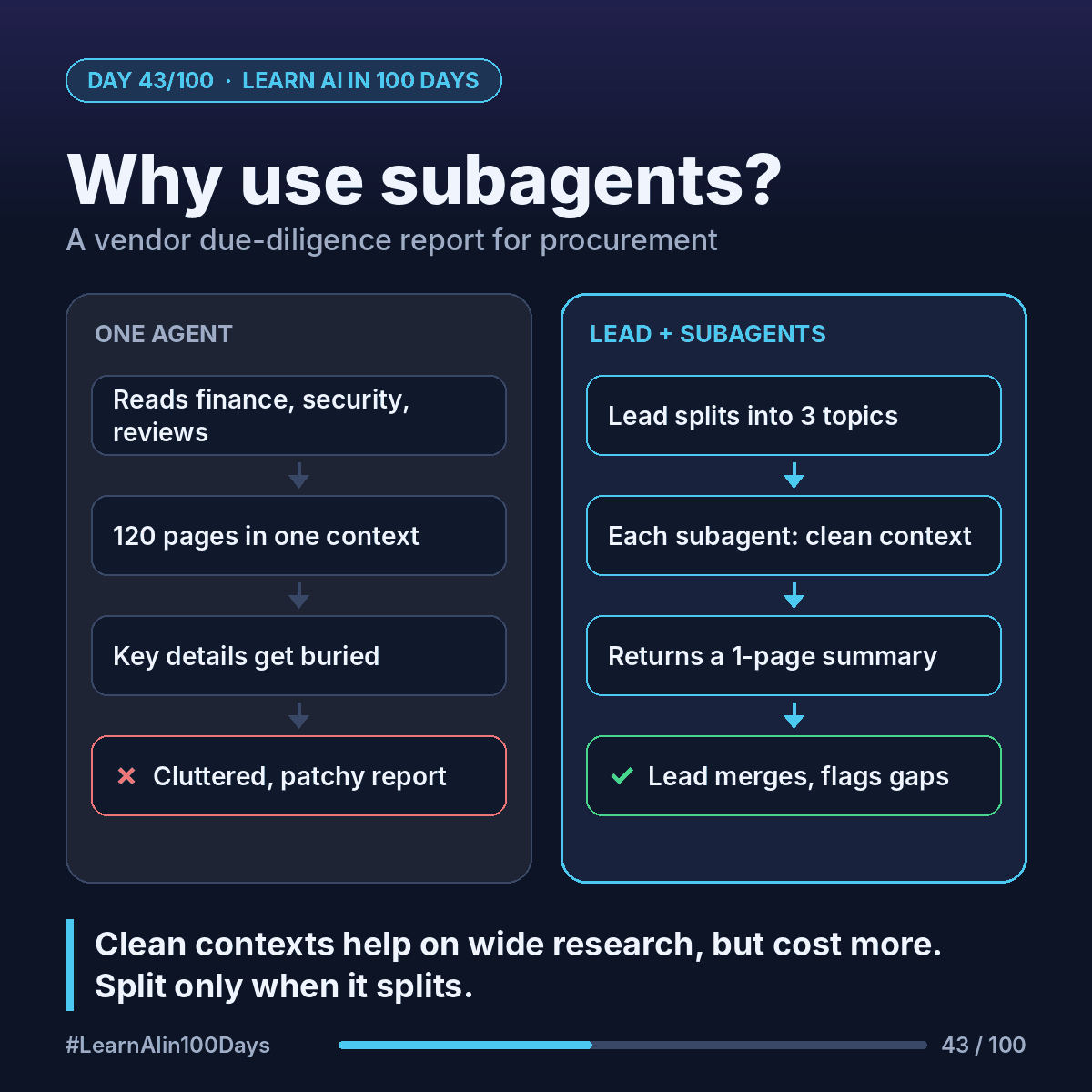
Why bother? Context (Day 20). One agent doing everything fills its context window with search results, PDFs and dead ends from every topic. Important details get buried ("lost in the middle"). A subagent starts with a clean context that holds only its own task.
Like a consulting lead who sends three analysts out, then reads their one-page memos, not every source.
Walkthrough: vendor due diligence for procurement
Goal: a due-diligence report on a new payments-software vendor before the contract is signed.
The lead agent plans and splits the work:
- Subagent 1, financial health: annual reports, funding, signs of instability.
- Subagent 2, security and compliance: certifications claimed, published security pages, data-residency terms.
- Subagent 3, customer reviews: what clients say about support and outages.
Each subagent:
- Gets clear instructions: the question, sources and output format.
- Runs its own agent loop (Day 36) with its own tools.
- Say it reads 40 pages, then returns a one-page summary with sources.
The lead agent:
- Receives 3 short summaries, not 120 pages.
- Spots conflicts (reviews mention an outage the security page doesn't).
- Merges one report, flags open questions, hands it to procurement.
The costs, and when not to use it
- More tokens: several agents, each reading and writing, often use several times what one agent would.
- Coordination: vague handoffs mean duplicated or missed work.
- Harder debugging: when the report is wrong, which agent caused it?
Skip it when the task is small, the steps are tightly linked, or one agent with good tools already does the job. It shines when the work splits into independent, research-heavy parts.
Where you see it at work
- Business analysis: market or competitor research split by region or product line.
- Banking: third-party risk reviews that cover financial, cyber and compliance angles.
- Healthcare: literature summaries split by question, merged for a clinical team to review.
In one sentence
Multi-agent systems give each part of a big job its own clean context, which helps on wide research but adds cost, so use them only when the work truly splits.