The concept
Planning: the agent breaks a big goal into smaller steps, works out which steps depend on others, then executes them in the agent loop (Day 36), using tools (Day 37) and tracking progress as state (Day 39).
Three ideas carry most of it:
- Decomposition: split the goal into steps small enough to do with one tool call or one prompt.
- Dependencies: some steps need others first. You can't chart revenue before you have the sales data.
- Re-planning: when a step fails or a surprise appears, update the plan instead of plowing ahead.
Walkthrough: an agent prepares a QBR
Goal: "Build the Q3 business review deck for the retail banking team by Thursday."
The plan the agent writes first:
1. Pull Q3 sales data (file from finance)
2. Pull Q3 customer complaints summary
3. Calculate KPIs: revenue vs target, new accounts, complaint rate
4. Compare to Q2
5. Draft 3 key insights
6. Build slides
7. Draft speaker notes
Dependencies: steps 1 and 2 can run in any order. Step 3 needs both. Step 6 needs 3, 4 and 5.
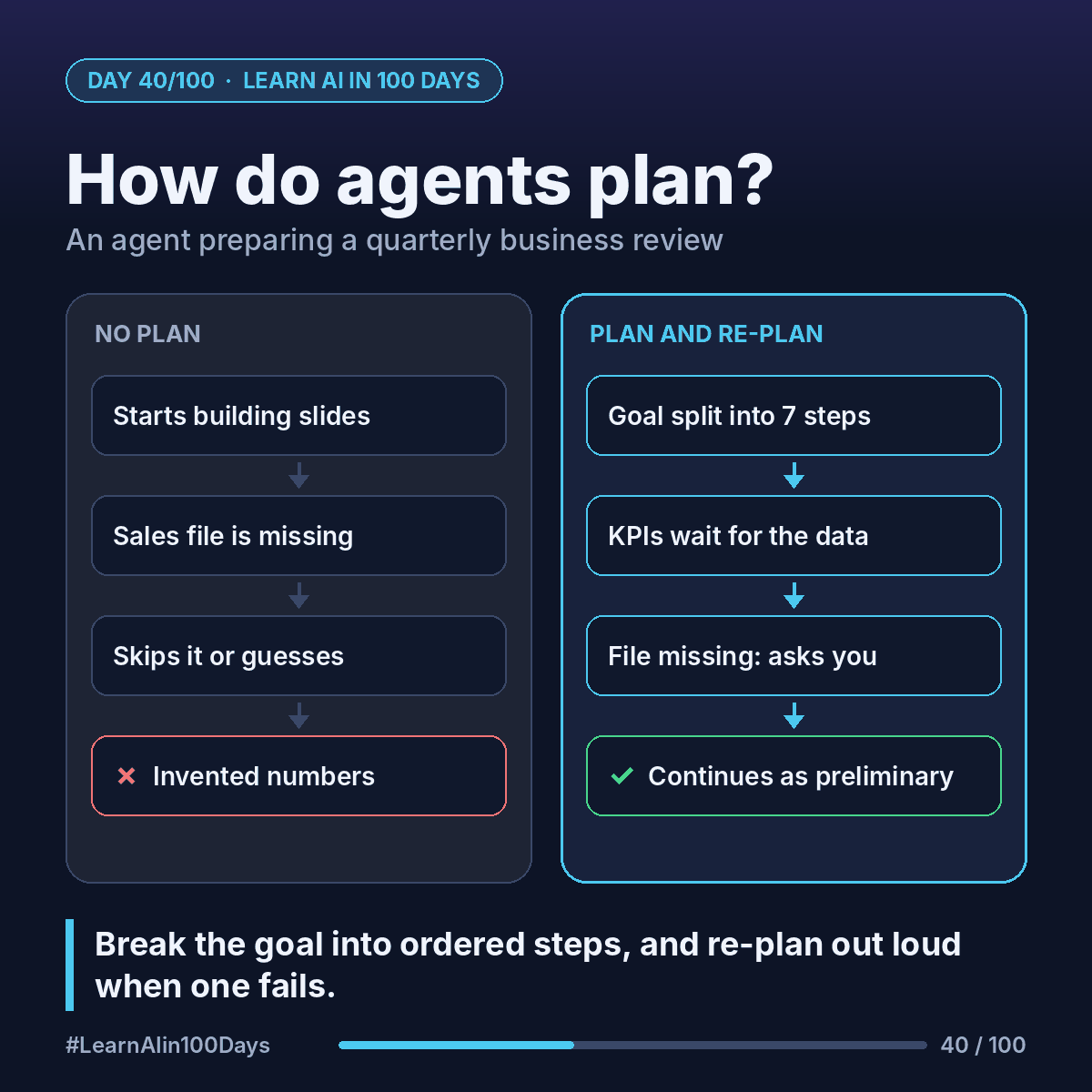
Then reality: step 1 fails. The sales file isn't in the shared folder.
A naive agent skips it, or worse, invents numbers (Day 22).
A planning agent re-plans:
- Mark step 1 as blocked.
- Do what doesn't depend on it: complaints summary, slide template, Q2 baseline.
- Ask: "The Q3 sales file is missing. Should I request it from finance, or use the preliminary dashboard export dated Oct 3?"
- You choose the dashboard export. The agent updates the plan, labels the slides "preliminary", and continues.
Two styles of planning
- Plan-then-execute: write the full plan up front, then run it. Easier to review and audit. Can be rigid.
- Step-by-step: decide only the next step each time, based on what just happened. Flexible, but can wander and is harder to predict.
Many agents mix both: a rough plan, adjusted after each step.
Where you see it at work
- Business analysis: a visible plan you can review before the agent touches data.
- Banking: month-end reporting where one missing feed should pause dependent steps, not skip them.
- Insurance: claim reviews where documents arrive out of order.
- Product management: plans are like a sprint board; dependencies and blockers matter more than speed.
In one sentence
Good agents break a goal into ordered steps, respect what depends on what, and re-plan out loud when something goes missing.