The concept
A model is, at its core, a huge file of learned numbers called weights (Day 9). The real question is who holds that file.
- Open-weight model: the weights are published. You download them and run the model on your own servers or private cloud. "Open" usually means open weights, not always open training data, and licenses vary, so read them.
- Closed model: the provider keeps the weights. You send text to their API (a doorway one program uses to talk to another) and get an answer back.
Neither is "better". They trade control for convenience.
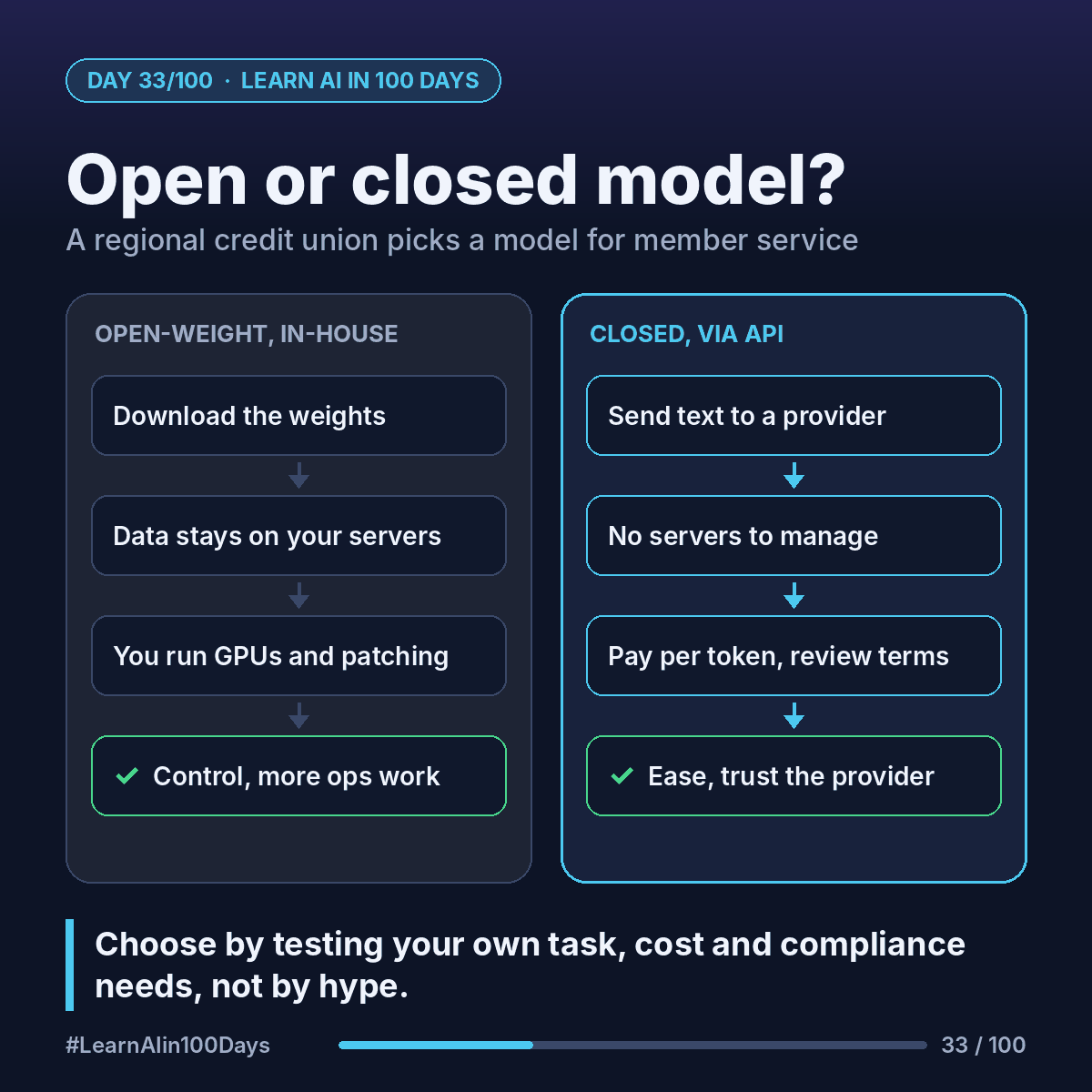
Walkthrough: a regional credit union picks a model
Goal: an assistant that helps member-service staff answer questions from internal policy docs, using RAG (Day 31).
Option A: open-weight model, run in-house.
- Member data never leaves the credit union's environment.
- They choose when to upgrade, so behavior stays stable.
- But they need GPUs (Day 13), people to run them, plus their own security patching and monitoring.
Option B: closed model via API.
- Strong capability on day one, no servers to manage.
- Pay per token (Day 16). Say 5,000 questions a day × 2,000 tokens each = 10 million tokens a day. Price that before you commit.
- But they must review the data terms: retention, whether data is used for training, where it is processed, and what the contract allows.
Their checklist:
- Task quality: test both on 50 real questions with known answers. Measure, don't assume.
- Cost: per-token bills vs hardware plus staff.
- Privacy and compliance: what regulators, auditors and members expect.
- Latency: does staff need answers in 1 second or is 10 fine?
- Team skills: who keeps it running at 2 a.m.?
Many teams land on a mix: a closed model for general drafting, an open-weight model for the most sensitive data.
Where you see it at work
- Banking: risk and compliance teams review where data goes before any model goes live.
- Healthcare: patient data rules push some workloads to models run inside the organization.
- Insurance: a vendor-risk review of an AI provider looks a lot like any third-party review.
- Product owners: the model choice belongs in the requirements, with acceptance criteria you can test.
In one sentence
Open-weight models give you control but you run them; closed models give you ease but you trust a provider, so test both on your own task, cost and compliance needs.