The concept
Yesterday (Day 35) we said an agent picks its own steps. Here's how.
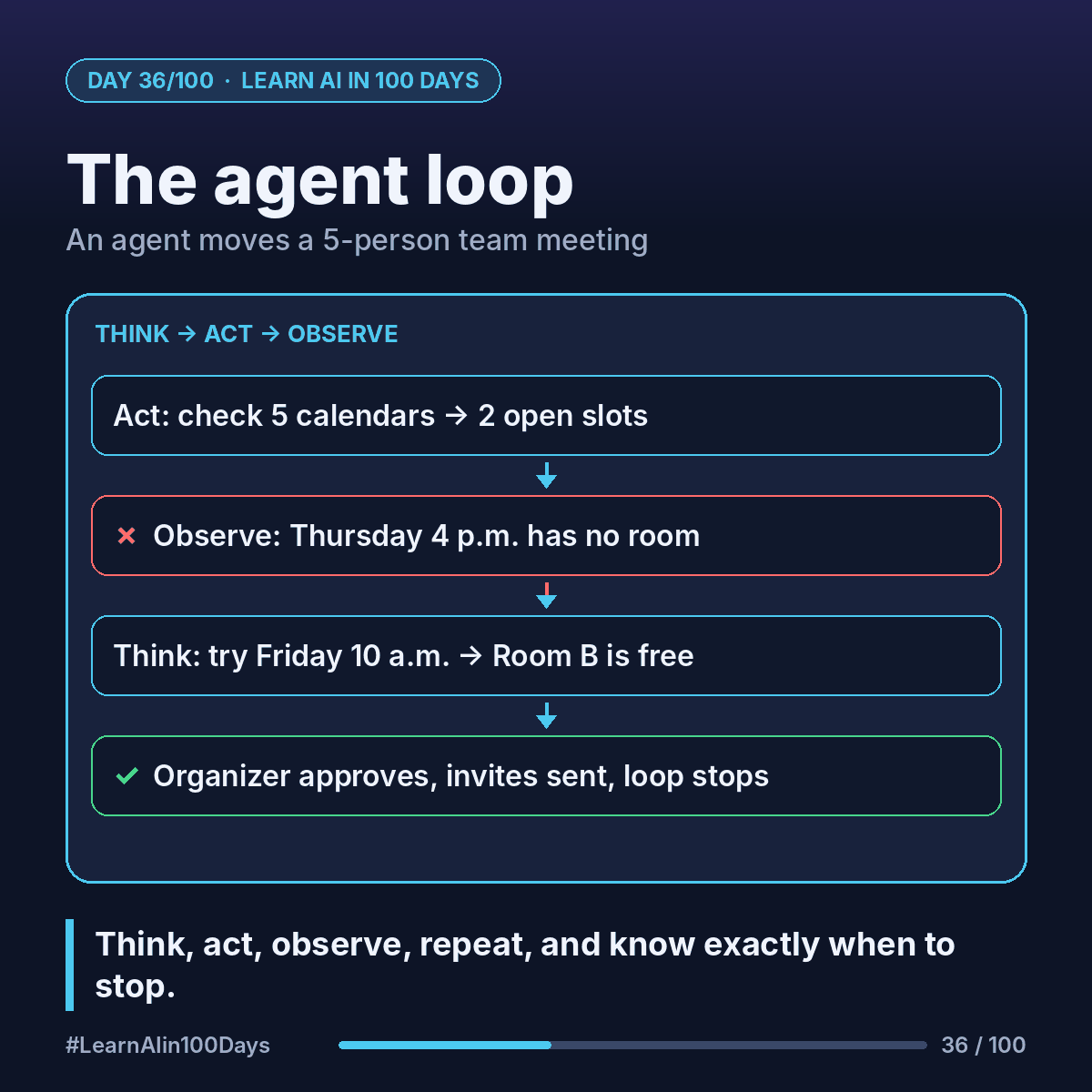
- Think: the model looks at the goal and everything so far, and decides the next step.
- Act: it calls a tool, like "check calendars" or "send invite". (Tools get their own post tomorrow.)
- Observe: the tool's result is added to the model's context (Day 20), so it can see what happened.
- Repeat: back to think, now with more information.
The loop ends on a stopping condition: the goal is met, the agent needs a human, or it hits a limit you set, such as a maximum number of steps.
Walkthrough: moving a 5-person team meeting
Goal: "Move Thursday's 2 p.m. project review to another slot this week. All 5 people must attend."
Loop 1
- Think: I need everyone's free time.
- Act: check 5 calendars for Thursday and Friday.
- Observe: say, two open slots, Thursday 4 p.m. and Friday 10 a.m.
Loop 2
- Think: Thursday 4 p.m. is soonest. Check a room.
- Act: search rooms for 4 p.m.
- Observe: no rooms free. Conflict.
Loop 3
- Think: try Friday 10 a.m. instead.
- Act: search rooms for 10 a.m.
- Observe: Room B is free.
Loop 4
- Think: everything lines up.
- Act: propose Friday 10 a.m., Room B, to the organizer for a yes before sending.
- Observe: approved. Invites go out. Goal met, loop stops.
Notice loop 2. The plan changed because of what the agent observed. A fixed workflow would have broken there.
Stopping conditions matter
Without them, an agent can loop forever, rebooking and re-checking, burning tokens (Day 16) and money. Good agents have:
- A clear "done" test (all 5 accepted).
- A step or cost budget (say, max 10 loops).
- A hand-off rule ("no shared slot this week? ask the organizer").
Where you see it at work
- Banking: a dispute agent checks the transaction, then the merchant record, then decides what to ask next.
- Healthcare: a scheduling assistant finds a slot that fits the patient, the doctor and the room.
- Product owners: write stopping conditions as acceptance criteria. "When is it done?" is a requirement.
In one sentence
An agent is a loop of think, act, observe, repeat, and the stopping conditions you give it matter as much as the goal.