The concept
Zero-shot: you ask with no examples. "Classify this complaint."
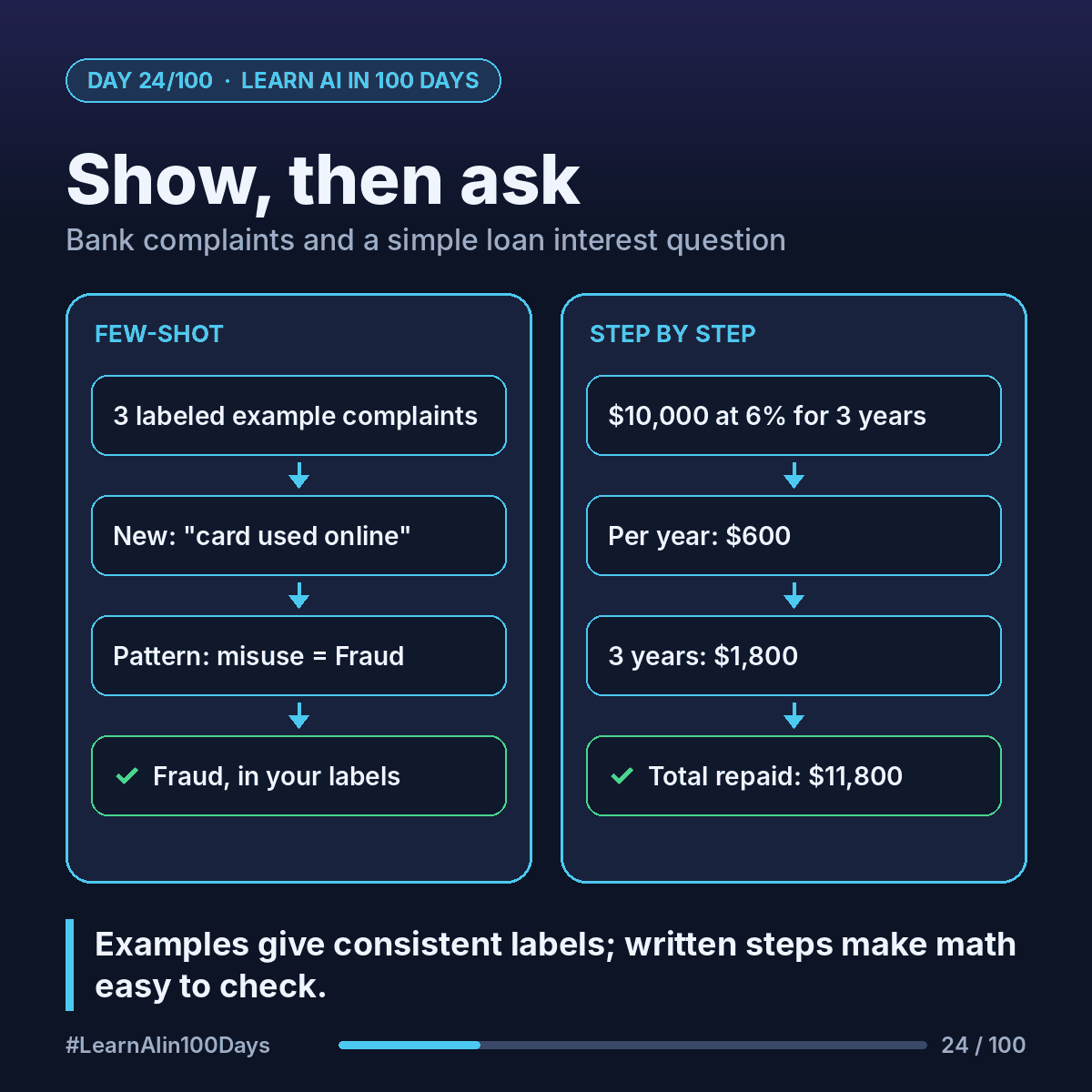
Few-shot: you include a few solved examples in the prompt, then the new case. The model copies the pattern: your labels, your format, your judgment calls.
No retraining needed (unlike fine-tuning, Day 19). The examples live in the prompt.
Step-by-step reasoning: asking the model to write out intermediate steps before the final answer. It produces text one token at a time (Day 16), so writing the steps gives it room to get multi-step problems right, and gives you something to check.
Walkthrough 1: sorting bank complaints
Categories: Billing, Card, Fraud, Other.
Prompt:
"Classify each complaint. Reply with the category only.
Complaint: I was charged a monthly fee twice. → Billing
Complaint: My card got declined at the grocery store. → Card
Complaint: There's a $400 purchase I never made. → Fraud
Complaint: 'Someone used my card number online to buy concert tickets.' →"
Answer: Fraud.
Without examples, the model might say "Card" (a card is mentioned) or invent a label like "Unauthorized use". The examples teach your boundary: unauthorized use is Fraud, card or not. Cover each category and include a tricky case.
Walkthrough 2: a simple loan interest question
"A customer borrows $10,000 at 6% simple annual interest for 3 years. How much do they repay in total? Work it out step by step, then give the final answer."
Step 1: yearly interest = 10,000 × 0.06 = $600
Step 2: interest for 3 years = 600 × 3 = $1,800
Step 3: total repaid = 10,000 + 1,800 = $11,800
Asked for just the number, a model can slip (say, $10,600, counting one year only). Writing the steps reduces those slips and shows you where any error is. For real loan figures, use a calculator or code; let AI explain, not be the system of record.
Where you see it at work
- Banking: routing complaints and emails with a few labeled examples per queue.
- Insurance: tagging claim notes (water damage, theft, liability) consistently across adjusters.
- Retail: sorting product reviews into delivery, quality, sizing, price.
- Business analysis: example user stories in the prompt so drafts match your team's template.
In one sentence
Show the model a few labeled examples to get consistent answers in your format, and ask it to reason step by step when the task has math or multiple steps.